
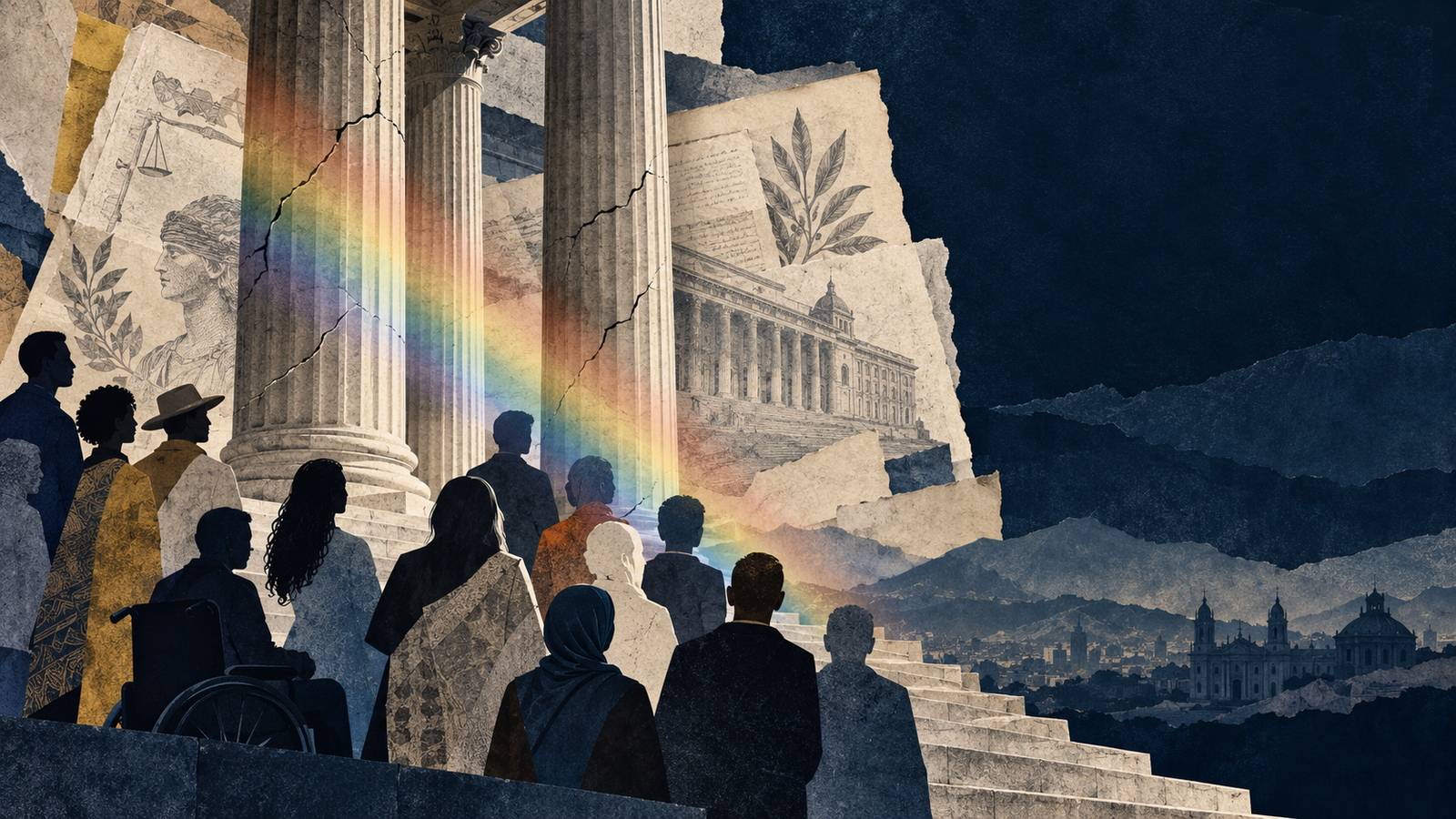
On September 17, 2026, the Colombian government announced the country’s immediate withdrawal from the Equal Rights Coalition, an intergovernmental alliance created in 2016 to promote and protect the rights of LGBTIQ+ people. This is not a merely symbolic body or an occasional meeting of governments. The Coalition coordinates diplomatic action, supports cooperation with civil society organizations, and advances policies against violence and discrimination.
The decision is even more troubling because Colombia was not a secondary participant. The country held the co-chairship with Spain and had earned a position of international leadership after years of institutional work. Leaving the Coalition while holding that responsibility is more than a change in diplomatic priorities. It means walking away from a political commitment the State had made to other countries and, above all, to a population that continues to face discrimination and violence.
The government argues that participation in this alliance is no longer a priority and that withdrawal does not affect rights recognized by the Constitution, the law, or the Constitutional Court. That answer contains a legal truth, but it conceals a political problem. Leaving the Coalition does not automatically eliminate marriage equality, adoption rights, legal recognition of gender identity, or the other protections developed through Colombian case law. Rights, however, do not survive simply because they remain written in a statute.
For a right to be real, institutions must protect it, budgets must support its enforcement, public officials must respect it, civil society must be able to monitor it, and governments must be willing to defend it. When a State declares that equality for a minority is no longer a priority, it sends a message that reaches far beyond foreign policy.
This withdrawal cannot be reduced to a disagreement between the current administration and its predecessor. Colombia’s engagement with this agenda did not begin under a single government. It grew through several administrations, Constitutional Court decisions, and years of work by human rights organizations. Calling it a project of the previous government ignores a basic democratic principle: fundamental rights do not belong to the president currently in office. They are permanent obligations of the State.
Authoritarianism does not begin by taking everything away
History shows that minority rights rarely disappear overnight. First, their legitimacy is questioned. Then, people are told that protecting them receives too much attention. The institutions that support them are weakened, channels for participation are closed, resources are cut, and discriminatory language becomes ordinary. By the time society reacts, much of the institutional ground has already been lost.
Fascist movements and other authoritarian governments have repeatedly used this method: select a minority, portray it as a threat to the family, religion, morality, or the nation, and reassure everyone else that there is no danger. While officials insist that nothing is happening, they gradually construct the legal, cultural, and administrative conditions for exclusion.
In Nazi Germany, persecution did not begin with the extermination camps. It was preceded by propaganda, the designation of internal enemies, the suspension of civil liberties, the removal of Jewish people from public employment, and the Nuremberg Laws of 1935, which stripped Jews of citizenship rights and prohibited marriages between Jews and people classified as being of German blood. Each stage prepared the next. Dehumanization came before mass violence.
Recalling that history does not mean that Colombia is in the same situation, nor that every conservative decision is fascist. Historical comparisons require care. The warning is more precise: fascism rarely introduces itself by announcing that it will abolish every right. It advances by normalizing smaller exclusions, discrediting those who object, and promising that general protections will remain untouched.
A similar pattern, in a different political context, can be seen in Russia. In 2013, the government enacted a law against so-called propaganda of nontraditional sexual relations, presenting it as a measure to protect minors. The restrictions later expanded. In 2023, Russia’s Supreme Court declared the supposed international LGBT movement extremist. That decision opened the door to the persecution of activists, organizations, meeting spaces, and public expressions related to sexual and gender diversity.
Hungary offers another warning. Under Viktor Orbán’s government, authorities restricted LGBTIQ+ content directed at minors, weakened legal recognition for transgender people, and used the defense of the traditional family as a tool of political mobilization. Broad constitutional guarantees did not disappear at once. The rollback took place through successive decisions that steadily narrowed the space for freedom.
None of these cases proves that Colombia will inevitably follow the same path. They do show why it is irresponsible to wait for open persecution before acknowledging a problem. Defending democracy means responding when commitments begin to be dismantled, not only after rights have already been removed.
Religion must not govern everyone
This debate also requires a clear distinction between personal faith and the exercise of public power. Every person has the right to practice a religion, change it, live by it, or have no religion at all. What a pluralistic democracy cannot accept is turning one religious belief into a compulsory rule for the whole of society.
Public officials may guide their private lives according to their faith. When exercising state power, however, they must act on the basis of the Constitution, evidence, human rights, and the public interest. The State governs people of different religions, as well as agnostics and atheists. It cannot select one spiritual doctrine and use it to restrict the freedom of those who do not share it.
History shows what happens when religious authority and political power become entangled. The Crusades began at the end of the eleventh century, following Pope Urban II’s call in 1095, and led to military campaigns justified in religious terms. They involved massacres, persecution, and displacement affecting Muslims, Jews, Eastern Christians, and even Christian communities in Europe.
The Inquisition was a different phenomenon. It emerged through medieval ecclesiastical tribunals and became especially powerful under the Spanish Inquisition, established in 1478 by the Catholic Monarchs with papal authorization. Its stated purpose was to police religious orthodoxy, but it also became an instrument of political and social control. Jewish converts, Muslim converts, alleged heretics, and others accused of departing from official doctrine were investigated, deprived of property, punished, and in some cases executed.
It would be inaccurate to claim that the Crusades or the Inquisition were identical to modern fascism. They belonged to different periods, institutions, and conflicts. Their shared warning lies elsewhere: political power becomes dangerous when it claims the authority to impose a religious truth and punish those who live, think, or believe differently.
Separating religion from government is not an attack on faith. It is the condition that allows every religion to exist freely. A secular State does not persecute believers. It prevents one religion from using state authority to dominate others and protects each person from the moral dictates of a majority.
Colombia’s 1991 Constitution established a pluralistic order and recognized freedom of religion. The Constitutional Court has repeatedly affirmed that the country has no official religion and that public institutions must remain neutral toward different faiths. That neutrality must also govern debates over LGBTIQ+ rights. A religious conviction may guide the conduct of the person who holds it, but it cannot by itself justify restricting another person’s life, family, identity, or dignity.
A warning that should not be minimized
Withdrawal from the Equal Rights Coalition does not erase Constitutional Court decisions today. It does, however, break a line of cooperation, weaken Colombia’s international role in protecting minorities, and suggest that these guarantees may depend on the ideological preferences of each administration.
It is also troubling that a decision of this kind was made without meaningful dialogue with the organizations that understand the lived conditions of LGBTIQ+ people. Democratic government is not limited to winning elections. It requires listening to those who may be affected, explaining public decisions, and subjecting power to scrutiny.
Some will reply that nothing has been prohibited and that existing rights remain in force. That is precisely how many rollbacks begin: calls for calm accompany the dismantling, one piece at a time, of the structures that made protection possible. A country leaves an international body, a program is canceled, a budget is reduced, openly hostile officials are appointed, and those who object are dismissed. Each measure may look minor in isolation. Together, they may reveal a political direction.
Not every ideological disagreement is fascism. Using the word for every dispute strips it of meaning. Yet it would be equally naive to ignore strategies historically used by fascist movements: dividing society between legitimate citizens and suspect minorities, portraying diversity as a threat, combining nationalism with moral dogma, and advancing gradually while insisting that no one is losing any rights.
Colombia still has a rights-protecting Constitution, an independent Constitutional Court, and a civil society capable of resisting democratic backsliding. Those strengths must be defended before they are weakened. It is not enough to point out that legal protections remain on the books. We must ask whether the State retains the will to uphold them.
The question is not only which right was removed on September 17. The deeper question is why equality for some Colombians stopped being a priority for their own government. When a State begins withdrawing from the institutions created to protect minorities, the democratic response cannot be silence and delay. Rights are also lost when society accepts, step by step, that defending them no longer matters.
Sources
If you believe this reflection matters, share it.