
By Mirada Pública | International analysis
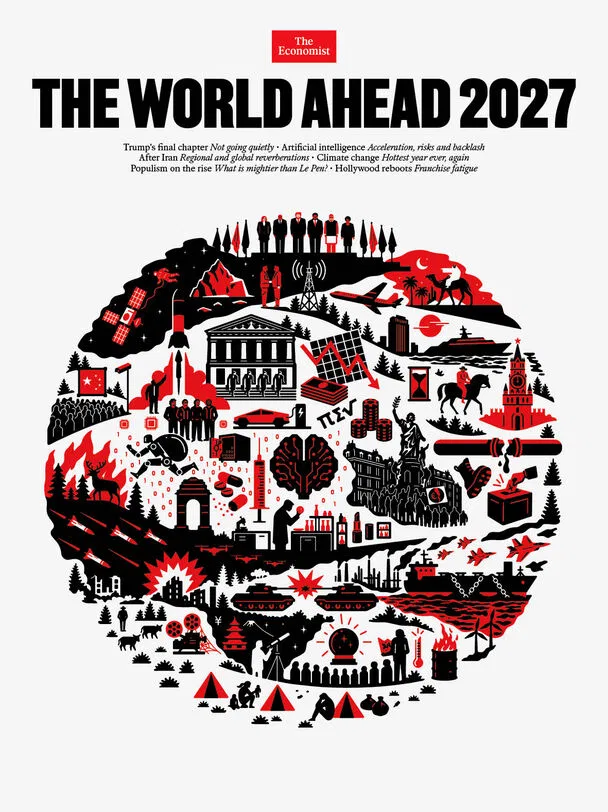
Every November, the same thing happens. The Economist publishes the cover of The World Ahead, and within hours social media fills with threads that “decode” it as if it were a secret map of what the elites have already decided. With the 2027 edition, published on November 17, the ritual returned: fighter jets, a falling stock-market chart, humanoid robots, forests on fire, refugee tents, and a skyscraper bearing Trump’s seal.
We do not need to believe in conspiracies to take the image seriously. We only need to read what the magazine itself says it wanted to portray.
What the magazine actually said
The illustration is by Cleon Peterson, and its composition is easy enough to understand: an elite at the top; ordinary people below, dealing with the consequences. Tom Standage, the issue’s editor, explained that the image is built around ten specific trends.
The United States will begin imagining life after Trump, although Standage warns that the president will not leave quietly. The world will continue to bear the aftermath of the war with Iran, including a fertilizer shortage that threatens the food security of millions. A super El Niño could make 2027 the hottest year on record. France will elect a president, and Marine Le Pen has a real chance. China is approaching the point when, according to several reports, its military was supposed to be ready for an operation against Taiwan. And artificial intelligence is linked to economic turbulence and growing backlash against big tech.
That is not a prophecy. It is an agenda of risks already on the table.
Power above, consequences below
If there is one message to take from the cover, it is its vertical arrangement. Decisions about war, money, and technology are concentrated in very few hands, while the effects fall on crowds who were never consulted.
Take war. The planes and missiles surrounding the illustration do not announce a third world war, but they do suggest a world that spends more on defense and grows used to several conflicts at once: Ukraine, the Middle East, the Taiwan Strait. Each one makes something more expensive. The war in Iran showed up in fertilizer prices, and fertilizer prices end up on the dinner plate.
Take money. The falling chart connects with a warning The Economist has repeated since last year: wealthy countries are spending more than they have, and a crisis in the bond market no longer sounds far-fetched. If one comes, pensioners and workers whose jobs depend on credit will pay for it, not fund managers.
And take technology. Robots and artificial intelligence promise productivity. I am interested in a more down-to-earth question: if a company produces twice as much with half the staff, where does that difference go? Without clear rules, it goes to the same people as always.
Democracy as a field of contest
The magazine’s decision to put France among its central themes says a lot. Right-wing populism has been growing in Europe for years, and 2027 could be the year it reaches the presidency of one of the European Union’s founding countries.
Democracies rarely break in a single blow. They wear down when their own tools—elections, courts, the media—are used to weaken checks on power. In Latin America, we know that pattern by heart.
Climate and the human body are political, too
Forests on fire are not decoration. A super El Niño means droughts in some regions and floods in others, lost harvests, and pressure on electricity systems. Colombia has already experienced a version of this: in 2024, drought led to water rationing in Bogotá.
The magazine also counts medical advances among the year’s opportunities. New treatments for obesity and the longevity industry’s promises exist, but they come at a price. Whether they work is one question; whether anyone beyond a minority can afford them is another.
And what about us?
Latin America is not at the center of the illustration, but that does not put it beyond its reach. For Colombia, the risks of 2027 have specific names: higher fertilizer costs for farmers, an El Niño that could hit hydroelectric generation, a peso exposed to any shock in debt markets, and a relationship with Washington that will depend on how the post-Trump transition unfolds. There is also pressure to choose sides between the United States and China, when what serves us best is not having to choose.
My reading
I do not see a conspiracy or master plan in this cover. I see something more uncomfortable: an inventory of problems that already exist, which an influential magazine chose to draw in a single frame.
The concern is not that the world changes; it always does. It is that fewer and fewer people decide where it is headed, while more and more people pay the price.
That is the question 2027 leaves us with. What will happen matters less than who decides it and who pays the bill.
This column is an editorial interpretation of the cover and the themes The Economist presented for 2027. It does not claim that each symbol announces a confirmed event.
MIRADA PÚBLICA Political analysis beyond the headlines. 🌐 www.miradapublica.com
#MiradaPública #TheEconomist #TheWorldAhead2027 #Geopolitics #LatinAmerica #Colombia
Sources
Colombian American political scientist and Master of Public Administration (MPA) candidate at Post University in Waterbury, Connecticut. He writes about democracy, human rights, institutions, and public affairs.