
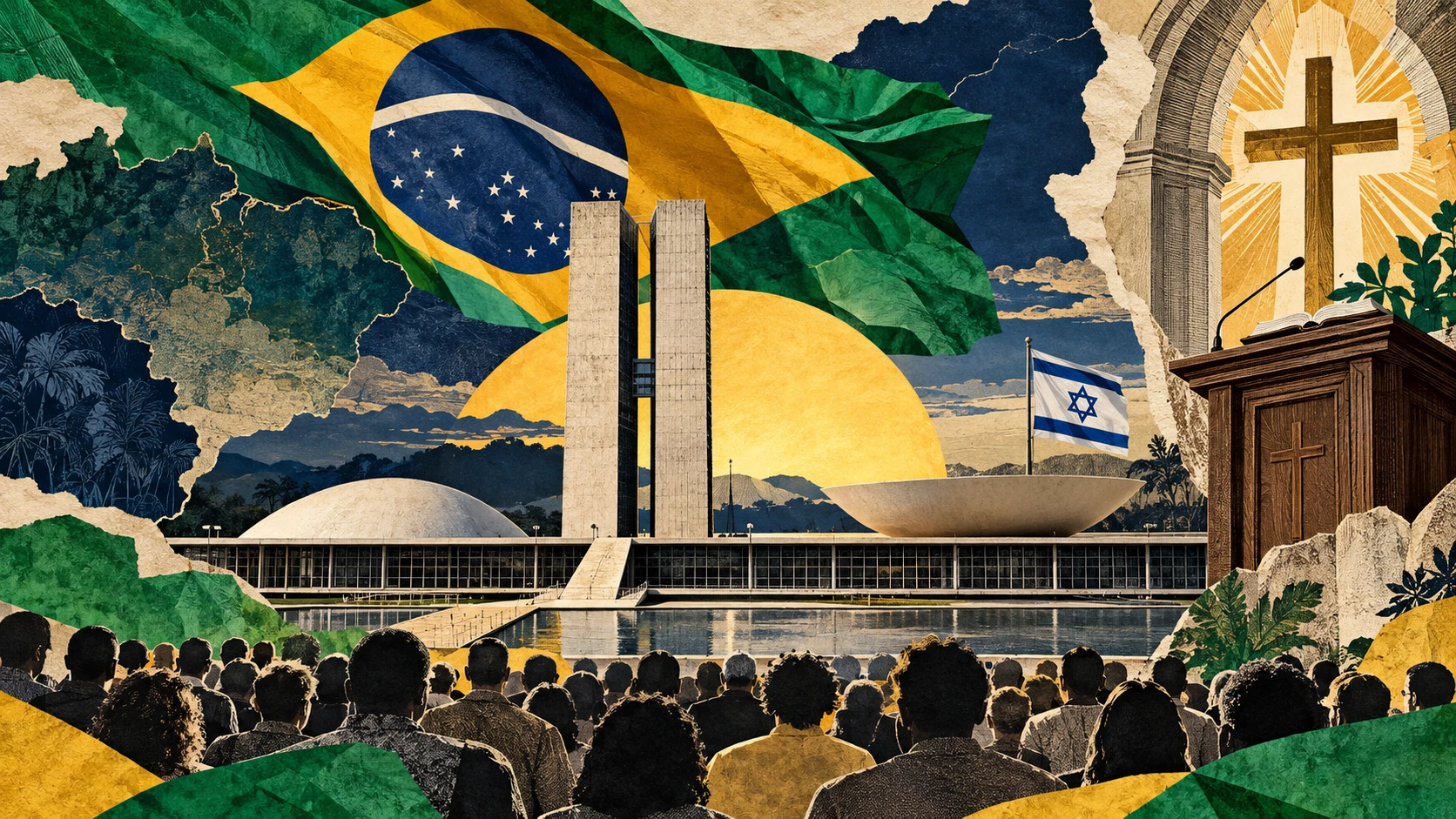
A woman draped in the Israeli flag accompanied Flávio Bolsonaro as he addressed his supporters after the first round of Brazil’s presidential election. The scene, described by Associated Press, raises a question that deserves more than a reaction on social media: how do right-wing nationalism, certain Christian churches, and political support for Israel intersect? [1]
Before answering, we need to establish what happened. Brazil has not yet elected its president. The Superior Electoral Court reported that Flávio Bolsonaro received 47.03% of valid votes and Luiz Inácio Lula da Silva 45.16%. They will contest the runoff on October 25. The right finished first; the presidency remains undecided. Confusing those facts would mean beginning a critical analysis with a falsehood. [2]
The result nevertheless shows that bolsonarismo retains its ability to mobilize. Jair Bolsonaro’s defeat in 2022 did not dismantle the movement he built. His son now enters the runoff with a lead, in a region where the right has regained ground. Chile offers a recent example: José Antonio Kast took office as president in March 2026, following Gabriel Boric’s government. There is a conservative shift in parts of Latin America, although the story is not identical in every country. [3]
That advance requires a more serious explanation than attributing it to voters’ ignorance. Someone who is afraid to go outside or feels that their income is insufficient may find a promise of order attractive. The right turns those concerns into simple messages. My criticism begins where that promise presents rights as obstacles and force as a substitute for accountable public policy. Security is a responsibility of the state; it should not become a blank check for authoritarianism.
The left cannot absolve itself of responsibility either. Invoking social justice is insufficient if a family still has no answers to crime, debt, or the cost of living. A progressive project that stops listening to those concerns makes it easier for its opponents to occupy that ground. That is a political interpretation of the result, not a claim that all voters shared the same motivation.
From the pulpit to the electoral contest
It would be absurd to minimize the importance of religion. According to the 2022 census results, evangelicals accounted for 26.9% of Brazil’s population aged ten and older, while Catholics accounted for 56.7%. That is a broad and diverse religious landscape, not a record of electoral preferences. [4]
Support for bolsonarismo among some evangelical groups is documented. Reuters reported in 2022 on that electorate’s support for Jair Bolsonaro and Lula’s efforts to win it over. The relationship between faith and voting therefore did not begin this week, nor does it belong exclusively to one campaign. [5]
The democratic problem arises when spiritual authority is used to present a candidacy as a divine mandate. If an opponent stops being someone with debatable proposals and instead represents evil, deliberation loses ground. A leader can end up protected by their religious identity, even when their decisions deserve scrutiny.
Religious believers have every right to participate in politics. They must also retain the freedom to disagree with their pastors. No church should claim ownership of its members’ votes, and no candidate should use God as a credential that exempts them from explaining how they will govern.

The Israeli flag and Christian Zionism
Here it is useful to name things precisely. The flag appearing at those events is the flag of the State of Israel. Calling it simply a “Jewish flag” confuses a diverse religious and cultural identity with a state and its political alliances.
Its presence in bolsonarismo has precedents. In 2020, Brazilian Jewish representatives criticized the use of Israeli flags at pro-Bolsonaro demonstrations that challenged democratic institutions. That reaction shows precisely that the Jewish community does not constitute a bolsonarista bloc. [6]
Part of the explanation lies in Christian Zionism: movements that assign religious significance to Israel and promote political support for it. Research published in Ciencias Sociales y Religión and Religion, State and Society examines how those beliefs relate to evangelical leadership, transnational networks, and diplomatic decisions in Brazil. The phenomenon combines religious convictions and political interests; reducing it to private devotion would be insufficient. [7][8]
In certain settings, the flag acts as a sign of belonging to that alliance. But a photograph does not prove foreign financing or establish that Israel is directing an election. Those accusations would require different evidence. What is documented already deserves examination: the convergence of conservative projects, religious authorities, and support for the Israeli state.
Criticism should address those alliances and their consequences. Israeli governments can be questioned about their policies, like any other government. Jews, as a people or religious community, are not collectively responsible for those decisions. Maintaining that distinction strengthens the argument and prevents political criticism from reproducing prejudice.
A citizen must be able to question their president and disagree with their pastor without becoming an enemy of the nation or of God.
What is at stake in Brazil
Brazil requires us to look beyond vote shares. The contest is also about who defines the nation, who may dissent, and which rights survive when a majority seeks to impose its morality on society as a whole.
The right has the right to compete in and win elections. That right does not make its proposals immune to criticism, nor does it allow electoral victory to justify weakening checks on power. The same standard must apply to the left.
On October 25, Brazilians will choose between two candidates. For those of us who defend a plural democracy, the task does not end with preferring one: it requires asking how that candidate will address material needs without sacrificing freedoms. A citizen must be able to demand security, question their president, and disagree with their pastor without anyone turning them into an enemy of the nation or of God.
Sources
References in the text link to this list. Facts are distinguished from the author’s interpretation and opinion.
- Associated Press: first-round election coverage, October 4, 2026.
- Superior Electoral Court: Flávio Bolsonaro and Lula will contest the runoff, October 5, 2026. Percentages are taken from the statement consulted; absolute figures subject to counting updates are not reproduced.
- Reuters: José Antonio Kast takes office as president of Chile, March 11, 2026.
- Agência Gov: religious affiliation results from the 2022 census, released in June 2025. The percentages refer to the population aged ten and older.
- Reuters: evangelical support for Bolsonaro, October 27, 2022.
- The Times of Israel: Brazilian Jewish representatives criticize the use of Israeli flags, May 5, 2020.
- Ciencias Sociales y Religión: El sionismo cristiano en Brasil en el siglo XXI y los intereses involucrados.
- Religion, State and Society: The recent rise of Christian Zionism in Brazil: church life and politics, 2025.