
Zion before Zionism
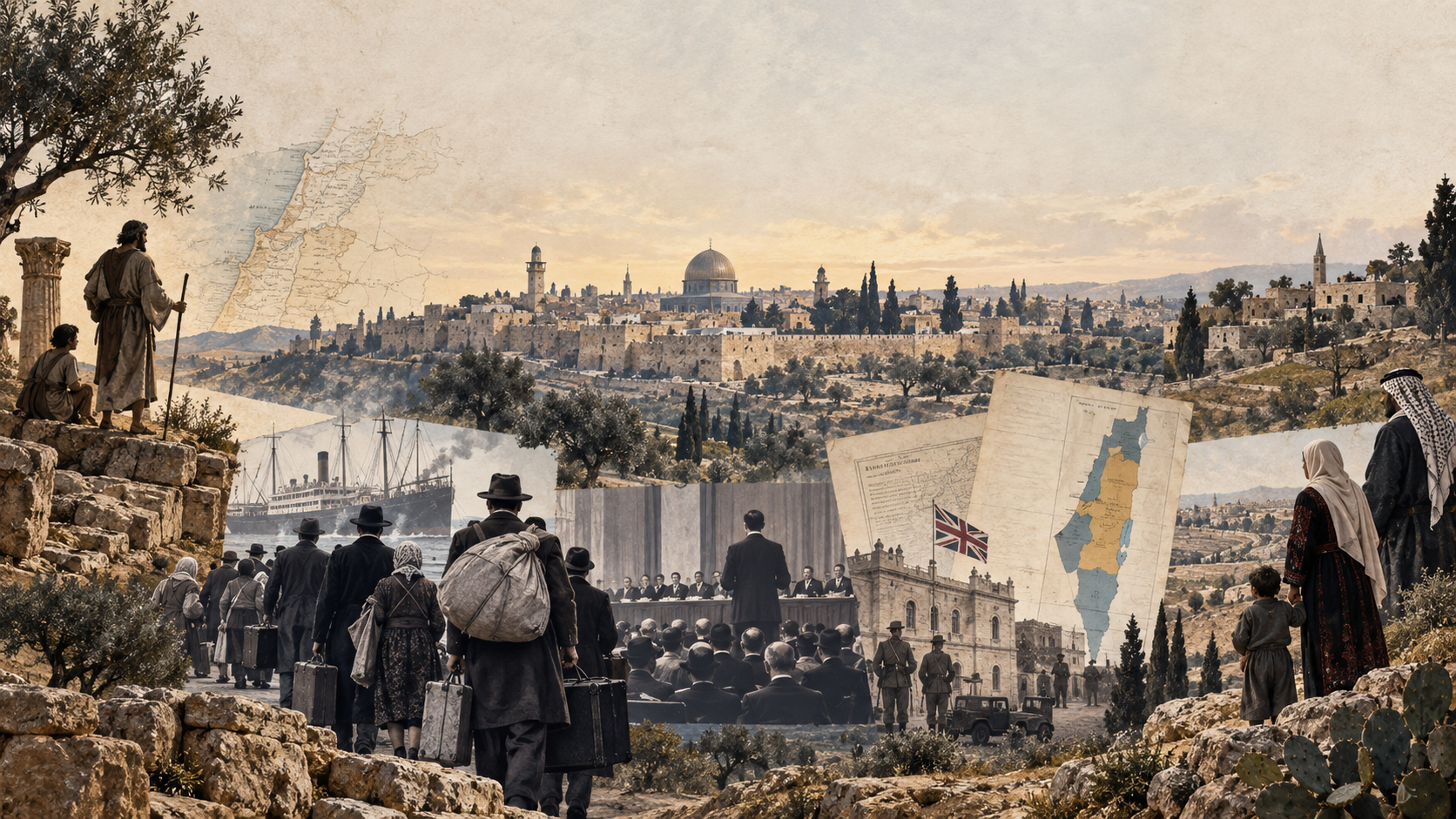
Zionism did not begin at a single moment, and it cannot be explained only through Theodor Herzl. Its background includes the Jewish people’s ancient relationship with the Land of Israel and Jerusalem. That historical and religious connection, however, should not be confused with modern Zionism, which emerged much later as a nationalist political movement.
The word Zion appears in the Hebrew Bible. It originally referred to a fortress in ancient Jerusalem, but eventually came to signify the city, the Land of Israel, and, symbolically, the Jewish people. Jerusalem was the religious center of the ancient kingdoms of Israel and Judah and the location of the First and Second Temples.
The Roman destruction of the Second Temple in 70 CE and later wars accelerated Jewish dispersal without eliminating the Jewish presence in the region. References to Zion remained part of prayer, festivals, and religious writing. This hope was primarily religious and messianic; it was not yet a program for creating a state through diplomacy, planned migration, and political institutions.[1]
The Europe that produced Jewish nationalism
Political Zionism emerged in nineteenth-century Europe. Emancipation gradually granted civil rights to Jews in several countries, while the Haskalah, or Jewish Enlightenment, encouraged secular education and integration. Many hoped citizenship would end their marginalization.
Antisemitism did not disappear. It assumed racial, political, and nationalist forms. Meanwhile, Italians, Germans, Poles, and other peoples pursued national unity or statehood. A question arose within this setting: if Jews were treated as a separate people, should they also claim national self-determination?[2]
Zionism was one response among several. Other Jews supported integration, socialism, cultural autonomy, or religious traditionalism. Some Orthodox groups opposed establishing a Jewish state before the arrival of the Messiah. Judaism and Zionism were therefore never interchangeable terms.
The forerunners: Hess, Pinsker, and the Lovers of Zion
In 1862, Moses Hess published Rome and Jerusalem, arguing that individual emancipation would not eliminate antisemitism. Pogroms in the Russian Empire after the assassination of Tsar Alexander II in 1881 gave this debate a different urgency.
Groups known as Hovevei Zion or Hibbat Zion—the Lovers of Zion—began promoting migration to Palestine and supporting agricultural settlements. In 1882, Leon Pinsker published Auto-Emancipation, arguing that Jews should not wait for other societies to resolve their insecurity.[3]
The First Aliyah began during this period, bringing migrants mainly from Eastern Europe and Yemen. Palestine was not an empty land. Its population was predominantly Palestinian Arab, Muslim and Christian, alongside longstanding Jewish communities. This fact shaped everything that followed.

Herzl and the Basel Congress
Theodor Herzl published The Jewish State in 1896. He did not invent every Zionist idea, but he brought scattered groups together and turned them into an organized international movement.
From August 29 to 31, 1897, he convened the First Zionist Congress in Basel. Delegates created the Zionist Organization and adopted the Basel Program, which sought to establish for the Jewish people a home in Palestine secured under public law. The word home, rather than state, preserved diplomatic ambiguity.[4]
The congress did not invent the Jewish connection to the land or initiate the first migration. Its significance was organizational: it supplied a program, leadership, and an international institution.
There was never a single Zionism
Political Zionism prioritized diplomacy, while practical Zionism emphasized migration and settlement. Labor Zionism combined nationalism and socialism. Cultural Zionism, associated with Ahad Ha'am, emphasized Hebrew language and a spiritual center. Religious Zionism joined the national project to Jewish tradition.
The Revisionist Zionism of Zeev Jabotinsky advocated a firmer territorial and military strategy and later influenced the Israeli right. Binational proposals and Jewish opposition to Zionism also existed. Treating Zionism as one unchanging doctrine erases disagreements about religion, borders, socialism, force, and relations with Arabs.
“Zionism responded to real persecution and, in seeking a territorial solution, came into conflict with the rights of the Palestinian population.”
The Palestinian question
The project contained a difficulty its leaders addressed in different ways: Palestine had its own population. Some Zionists believed economic development would benefit both communities. Others expected immigration to produce a Jewish majority. Some recognized that Arab opposition was a foreseeable response to the prospect of becoming a minority.
For Jewish immigrants escaping persecution, settlement could represent safety and national reconstruction. For Palestinians, the growth of a movement seeking a Jewish national home threatened their political position, land, and collective future. Both experiences belong to the history.
Balfour and the British Mandate
On November 2, 1917, the British government issued the Balfour Declaration. It supported establishing in Palestine a “national home for the Jewish people” while stating that the civil and religious rights of existing non-Jewish communities should not be harmed.[5]
The difference in language mattered: the declaration recognized a Jewish national aspiration but described the Arab majority as non-Jewish communities without expressly recognizing their national political rights. During the British Mandate, Jewish migration, Zionist institutions, Palestinian nationalism, and conflict all increased.
The Holocaust and the urgency of refuge
Nazi Germany and its allies and collaborators murdered six million European Jews. The Holocaust did not create Zionism; the movement had been organized for decades. But for many survivors and supporters, it demonstrated the failure of European states to protect their Jewish populations.[6]
After the war, hundreds of thousands of survivors remained displaced, and many could not or would not return to countries where their families had been murdered. Palestinians faced a different injustice: they were expected to bear territorial consequences for a crime committed mainly in Europe.
1947 and 1948: independence and Nakba
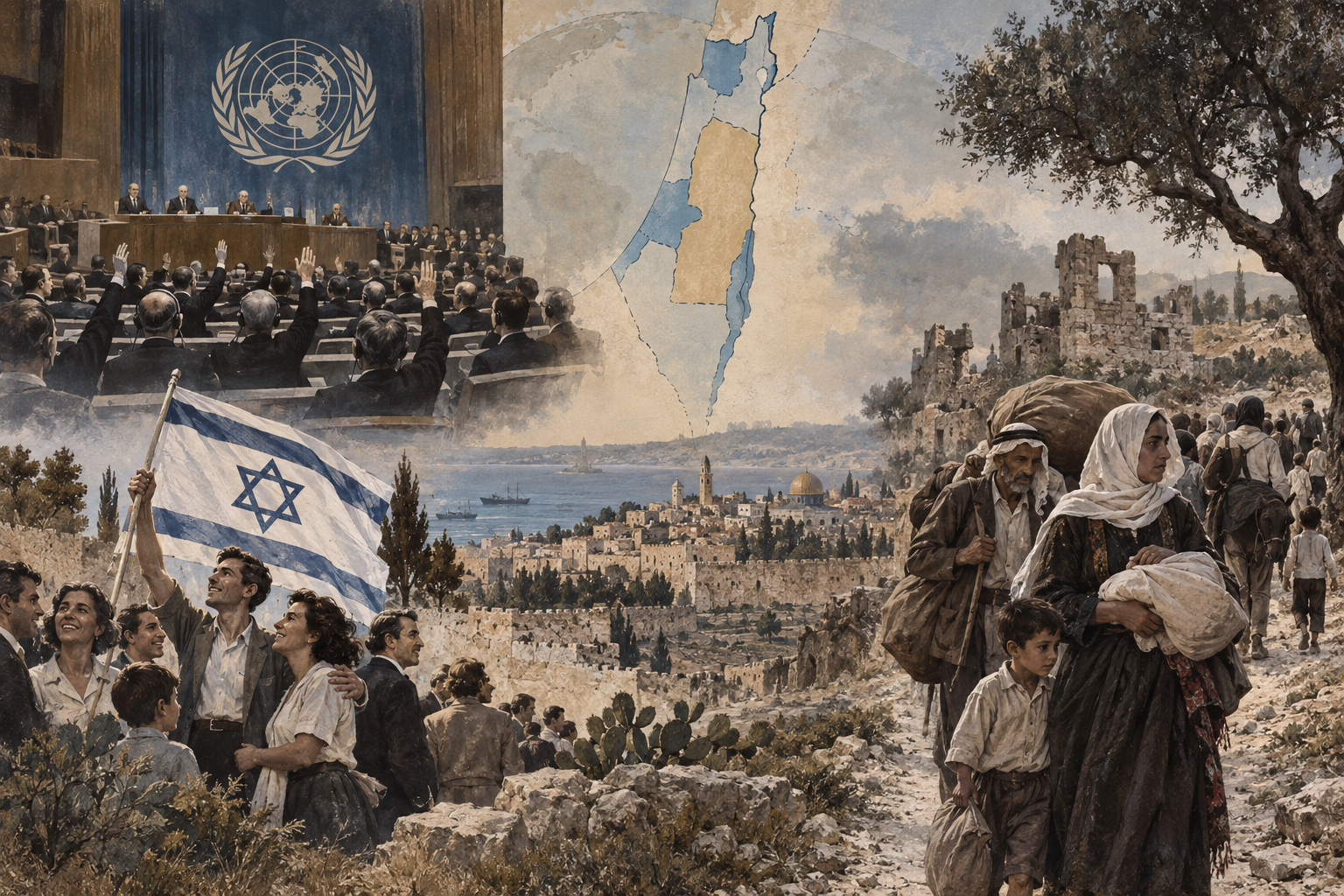
On November 29, 1947, the United Nations General Assembly adopted Resolution 181, recommending the partition of Palestine into Jewish and Arab states, with a special international regime for Jerusalem. Zionist leaders accepted the proposal as a basis for statehood; Arab leaders rejected a division made without the consent of the Palestinian majority.[7]
Israel declared independence on May 14, 1948. For Israelis, the ensuing war represents national independence. For Palestinians, it represents the Nakba—the catastrophe: mass displacement and dispossession during the conflict. The Arab state envisioned by the UN was not established.[8]
Acknowledging Jewish persecution and the search for safety does not erase the Palestinian experience. Acknowledging the Nakba does not justify holding Jews collectively responsible for Israel’s decisions.
What Zionism means after 1948
After Israel’s creation, Zionism became associated with the state’s preservation and character. Some currents support territorial compromise and Palestinian statehood; others promote settlements or annexation. Supporting Israel’s continued existence does not necessarily mean supporting its government.
A Pew Research Center survey conducted from October 2014 to May 2015 found that 30% of Israeli Jews said “Zionist” described them very accurately and another 44% somewhat accurately: 74% in total, not the 90% stated in one of the videos that prompted this article. Among Haredim, the combined figure was 33%.[9]
Alfredo Jalife’s term “Meta Israel” should be identified as his interpretation, not an accepted historical category. Lobbying, financing, and alliances can be studied through verifiable records. Claims that a Jewish or Israeli structure controls a continent require evidence the videos do not provide and may reproduce old antisemitic stereotypes.
Distinctions necessary for understanding
Judaism is a religion and historical tradition; Zionism is a family of modern political movements. Israel is a state, and its government is a specific administration subject to criticism like any other. Collapsing these categories prevents precise discussion.
Zionism responded to real persecution and, in seeking a territorial solution, came into conflict with Palestinian rights and aspirations. Understanding it requires recognizing both Jewish self-determination and Palestinian dispossession without replacing evidence with slogans or theories of collective control.
Sources and further reading
Numbered references in the article correspond to the institutional sources below.
- [1] USHMM — Postwar refugee crisis and the establishment of Israel
- [2] USHMM — Antisemitism in history: the era of nationalism, 1800–1918
- [3] National Library of Israel — History of Zionism
- [4] World Zionist Organization — First Zionist Congress and Basel Program
- [5] UK House of Commons Library — Balfour Declaration
- [6] USHMM — Antisemitism and the Holocaust
- [7] United Nations General Assembly — Resolution 181 (II)
- [8] United Nations — About the Nakba
- [9] Pew Research Center — Views of the Jewish state and the diaspora